The Resonance of Precision: Tuning Forks in Sound Healing, History, Science, and Therapeutic Practice
Tuning Forks in Sound Healing
Among all sound healing instruments, tuning forks are perhaps the simplest in appearance and one of the most precise in function. Unlike gongs, singing bowls, or flutes that create rich and evolving soundscapes, a tuning fork produces a remarkably pure tone — focused, direct, and highly specific.
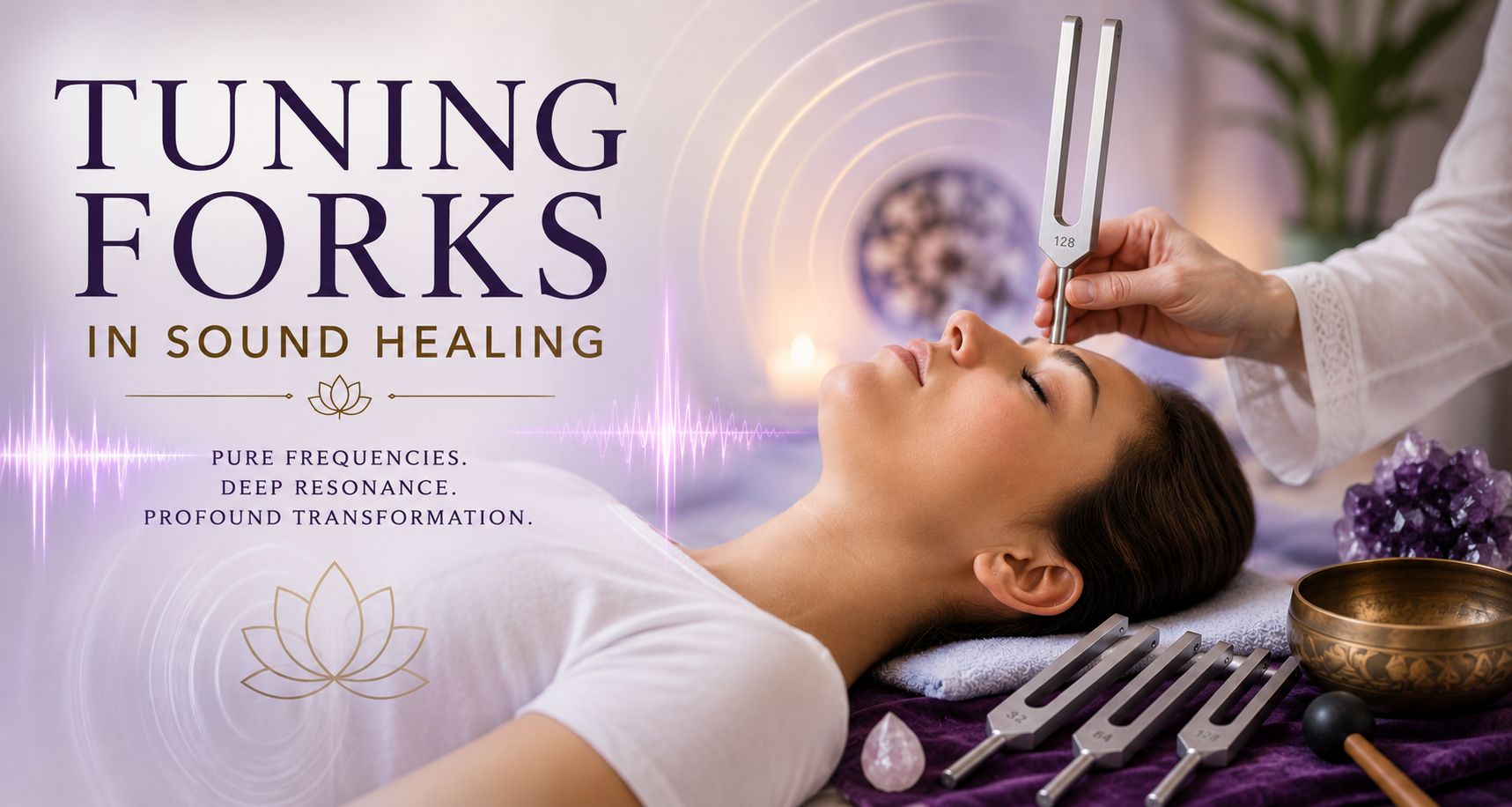
For sound healers, tuning forks occupy a unique position between music, medicine, physics, and energetic practice. They can be used both around the body and directly on it, creating experiences that range from deep relaxation to highly targeted vibrational work.
A Brief History
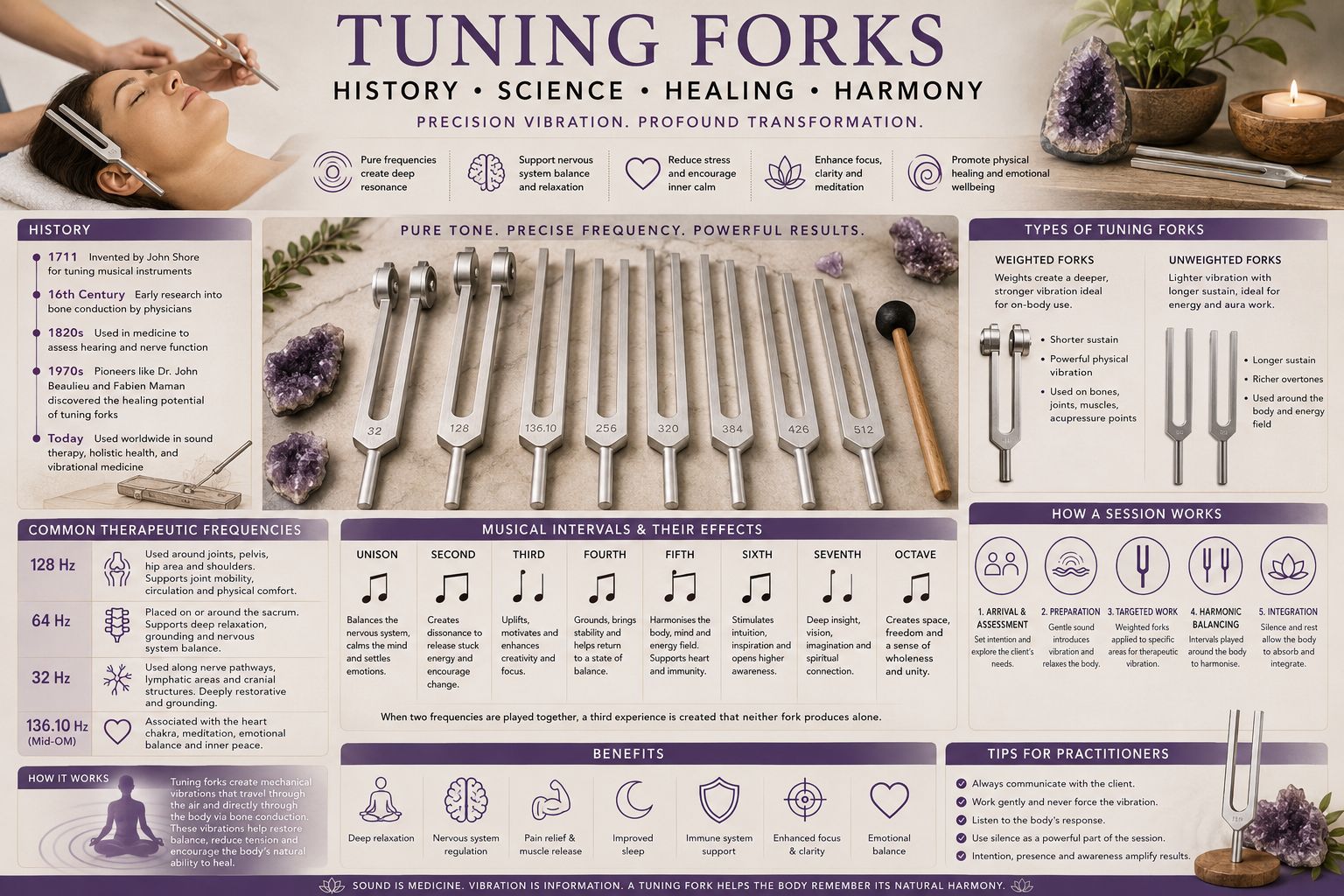
The tuning fork’s journey began not in healing, but in music and science. The first known tuning fork was invented in 1711 by English musician John Shore as a reliable pitch reference for tuning instruments. Its ability to generate a consistent frequency revolutionized musical accuracy and became a standard tool for musicians worldwide.
Physicians later began using tuning forks to assess hearing, test vibration perception, evaluate nerve function, and help identify certain types of bone injuries. The modern use of tuning forks for healing emerged during the twentieth century, when pioneers in sound therapy began exploring how precise frequencies could influence the body, mind, and nervous system.
Today, tuning forks are widely used by sound healers, bodyworkers, osteopaths, massage therapists, acupuncturists, and holistic practitioners throughout the world.
Why Tuning Forks Are Different
Most sound healing instruments create broad fields of frequencies. A gong produces thousands of overtones. A singing bowl creates layers of harmonics. A tuning fork does something entirely different — it generates an extremely pure and stable frequency, allowing practitioners to work with specific vibrations rather than broad sound fields.
Clients Often Describe the Experience As
- Clear and direct
- Subtle yet deeply calming
- Easy to feel inside the body
- Speaking directly to a specific area
Resonance and Bone Conduction
One of the most fascinating aspects of tuning forks is their ability to transmit vibration directly into the body. When a weighted tuning fork is placed on bones, joints, tendons, muscles, or connective tissue, the vibration travels through physical structures rather than through air alone — a process known as bone conduction.
Many clients report hearing the vibration internally while simultaneously feeling it physically. This makes tuning forks unique among sound healing instruments — the body becomes part of the instrument itself. A fork placed on the sacrum, sternum, or shoulder may create sensations throughout larger areas of the body.
How Tuning Forks Affect the Body and Mind
Relaxation
Pure frequencies help shift attention away from mental noise and into present-moment awareness.
Nervous System Regulation
Many practitioners use tuning forks to encourage balance between activation and relaxation states.
Pain Management
The vibration may help reduce muscular guarding and improve awareness of tension patterns.
Circulation and Nitric Oxide
Some studies suggest vibrational stimulation may encourage the release of nitric oxide — a signaling molecule associated with blood vessel relaxation, circulation, and cellular communication.
Stress Reduction
- Lower stress and reduced anxiety
- Better sleep quality
- Greater emotional calm
- Improved focus and clarity
Brainwave Shifts
Practitioners frequently observe that tuning forks support movement into relaxed alpha and theta states associated with meditation, creativity, and inner awareness.
Types of Tuning Forks
Unweighted Tuning Forks
Primarily used off the body — around the head, near the ears, around the chakras, and throughout the body’s surrounding energy field. Lighter vibration with a longer audible tone and richer harmonics. Practitioners often use pairs to create intervals and harmonic relationships that encourage relaxation and coherence.
Weighted Tuning Forks
Contain small weights attached to the ends of the tines, creating stronger physical vibration. Commonly placed on the sacrum, sternum, joints, muscles, tendons, and acupressure points. Their purpose is less about listening and more about feeling vibration within the body.
Common Therapeutic Frequencies
128 Hz
One of the most widely used weighted forks. Traditionally associated with joint mobility, relaxation, circulation, and physical comfort. Commonly applied around joints, pelvis, shoulders, and areas of muscular tension.
64 Hz
A deeper fork often used around the sacrum and lower body. Frequently incorporated into sessions focused on relaxation, grounding, sleep support, and nervous system balance.
32 Hz
The deepest fork in many therapeutic sets. Commonly used around nerve pathways, lymphatic work, cranial techniques, and deeply restorative sessions.
136.1 Hz — Mid-OM
One of the most popular meditation forks. Traditionally associated with heart-centered awareness, meditation, calm presence, and emotional balance. An excellent bridge between therapeutic and spiritual applications.
Musical Intervals: The Hidden Language of Tuning Fork Therapy
When two forks are activated together, they create a third experience that neither fork produces alone. Each interval carries a different quality and therapeutic intention.
Unison
Two identical tones. Associated with centering, stability, and emotional settling.
Second
A slightly dissonant interval used to encourage movement where energy feels stagnant. Associated with creativity, change, and fresh perspectives.
Third
A warm and emotionally expressive interval — motivating, encouraging, and emotionally uplifting.
Fourth
A grounding interval associated with stability, mental quieting, and emotional regulation.
Fifth
Perhaps the most widely used healing interval. Many practitioners consider the fifth naturally balancing and harmonizing — associated with nervous system coherence, whole-body integration, and expanded awareness.
Sixth and Seventh
Often used in more advanced work. Traditionally associated with inspiration, insight, imagination, and creative vision.
Octave
A powerful interval representing unity across different levels of vibration — experienced as spaciousness, freedom, and integration.
How a Professional Session Works
- Arrival and assessment — exploring areas of tension, discomfort, goals, or intention
- Nervous system preparation — gentle fork work near the ears or around the body
- Targeted vibrational work — weighted forks applied to joints, muscles, sacrum, and areas of tension
- Harmonic balancing — pairs of unweighted forks used around the body to create balancing intervals
- Integration — rest and silence, allowing the nervous system to absorb the experience
Choosing Your First Tuning Fork
For beginners, an excellent starting point is one 128 Hz weighted fork, one Mid-OM 136.1 Hz fork, and one pair of harmonic forks tuned to a fifth. This simple setup allows exploration of on-body vibration, meditation, harmonic relationships, and nervous system regulation — without becoming overwhelmed by too many options.
Safety Considerations
- Always communicate with the client
- Avoid excessive volume near the ears
- Use caution with acute injuries
- Reduce intensity for highly sensitive individuals
- Work gently around recent surgical sites
- Respect client comfort at all times
Healing comes through resonance, not force.
The Power of Silence
Tuning forks teach an important lesson: healing is not only found in sound. It is also found in the silence that follows. Every vibration eventually dissolves into stillness — and that stillness allows the body and mind to integrate the experience.
“Profound change does not always require intensity. Sometimes transformation begins with a single vibration.”
Their gift is not complexity. Their gift is precision — and through that precision, a deeper relationship with balance, awareness, and the subtle intelligence of vibration.
That was so useful, thank you so much 🙏🏻
I really appreciated how this highlights the precision of tuning forks. Unlike other instruments, their exact frequencies bring such an interesting, targeted scientific layer to sound healing. Thanks for covering both the history and the practical side so thoroughly!