The Gong: History, Types, Sound Healing Applications, and the Transformational Power of Resonance
The Gong in Sound Healing
The gong is one of the most powerful instruments used in sound healing. Its sound is deep, wide, unpredictable, and immersive. A single strike can create layers of tone that expand through the room, through the body, and through the nervous system.
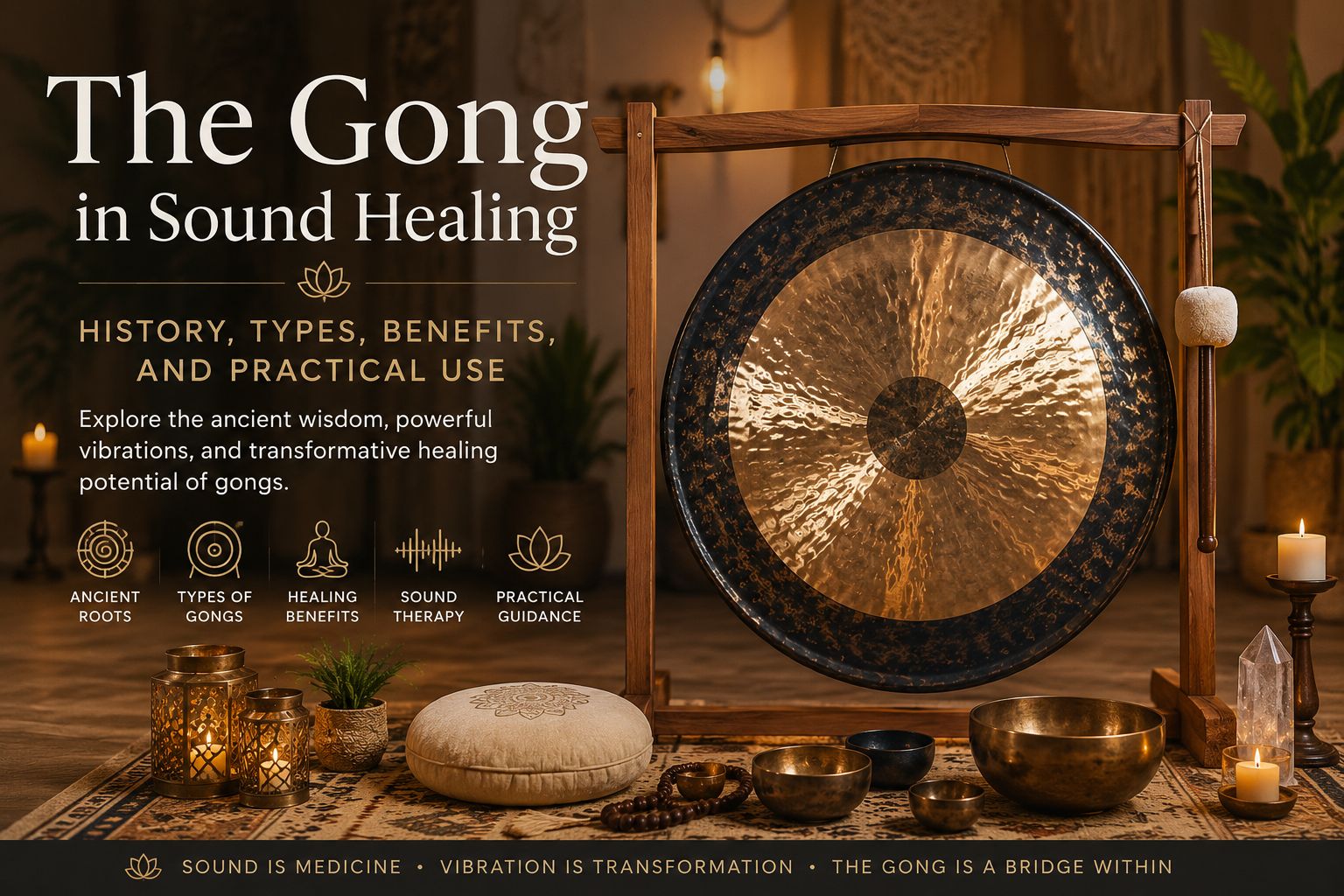
Unlike many musical instruments that produce a clear melody or fixed note, the gong creates a living field of vibration — speaking in waves, overtones, pulses, textures, and silence.
A Brief History
Gongs are ancient instruments with roots across Asia — China, Java, Burma, Vietnam, Bali, Borneo, Korea, India, and Tibet. For thousands of years, they were used in temples, ceremonies, rituals, royal courts, and spiritual practices.
In many cultures, the gong was not treated as a simple percussion instrument. It was seen as a sacred object — a carrier of power, a symbol of creation. Its deep and penetrating vibration was believed to clear stagnant energy, announce important transitions, and connect human consciousness with something greater than the ordinary mind.
Today, gongs are used in orchestras, meditation centers, yoga studios, healing spaces, and professional sound baths around the world. The modern use of gongs in sound healing is a continuation of this ancient relationship between sound, consciousness, and transformation.
Why the Gong Is Unique
The gong produces a complex spectrum of sound. When played, it does not create only one note — it releases a wide range of frequencies, overtones, harmonics, and inharmonic tones that move and change continuously.
This complexity is one reason the gong is so effective in sound healing. The mind cannot easily predict or control the sound. As a result, the listener often begins to surrender. Mental activity slows down, the body softens, and awareness shifts from thinking into feeling.
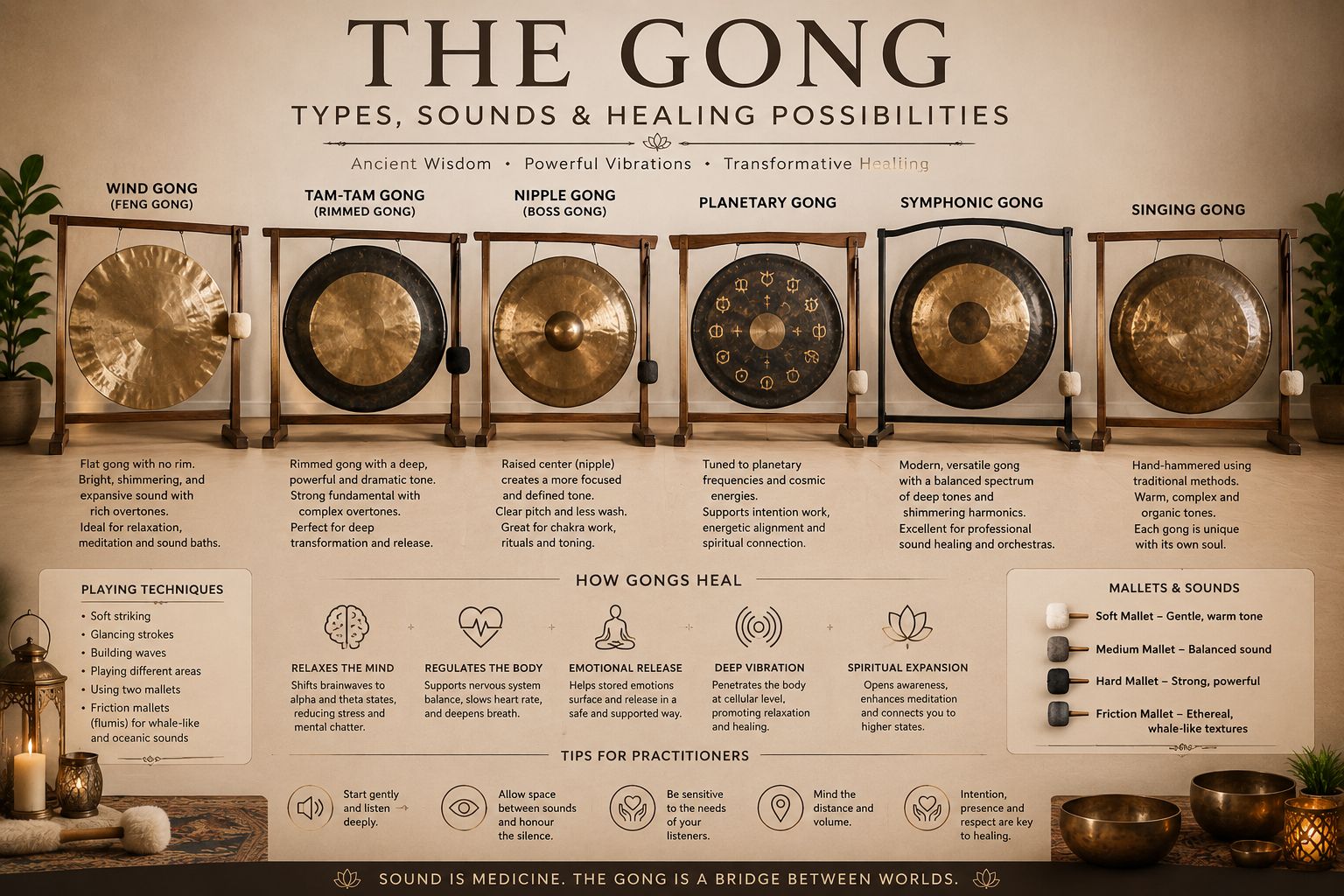
Main Types of Gongs
1. Wind Gongs
Flat gongs without a raised rim. Their tone creates a wide wash of overtones — spacious, fluid, and wave-like. Excellent for meditation, emotional release, and energetic cleansing.
2. Tam-Tam Gongs
Also known as Chao gongs, these have an upturned rim and produce a deeper, darker, and more dramatic sound. Large tam-tams can fill a room with a huge field of vibration — widely used in gong baths.
3. Nipple Gongs
Feature a raised center boss that produces a more focused and defined tone. Useful for ritual work, meditation, and sound journeys where a clearer note or centered vibration is desired.
4. Planetary Gongs
Modern gongs tuned according to frequencies associated with planets or cosmic cycles. Used for intention-based work to create a specific atmosphere or energetic theme within a session.
5. Symphonic Gongs
Designed to offer a balanced and versatile sound spectrum. Gentle enough for private healing sessions and powerful enough for large group sound baths. Widely used in professional sound healing.
6. Singing Gongs
Often handmade using traditional metalworking methods. Each has its own personality — some dark and earthy, others bright, mystical, or watery. Ideal for practitioners who want an organic and intimate sound quality.
How Gongs Are Used in Sound Healing
For Deep Relaxation
When played slowly and softly, the gong helps the body move into a calmer state. The breath slows, the muscles relax, and the nervous system begins to shift away from stress.
For Emotional Release
The gong can bring hidden emotions to the surface. Its sound bypasses the analytical mind and reaches deeper layers of feeling. The best gong work allows emotions to arise naturally and safely.
For Meditation
Instead of following thoughts, the listener follows vibration. Over time, this can lead to stillness, spaciousness, and expanded awareness.
For Nervous System Regulation
Sound healing with gongs can support parasympathetic activation — the body’s rest-and-recovery state. The slow development of sound and the deep frequencies can help regulate heart rate, breathing, and muscular tension.
For Sound Baths
Participants lie down while the practitioner plays one or more gongs. The sound builds gradually, moves through different textures, and then returns to silence. The most important element of a gong bath is not volume — it is sensitivity.
How the Gong Affects the Body and Mind
Brainwave Shifts
Gong sound can help guide the brain from active thinking states into slower states associated with relaxation and meditation — a space between waking and sleeping where the body is deeply relaxed but awareness remains present.
Breath and Heart Rhythm
As the gong sound expands, the body often synchronizes with the slower rhythm of the session. Breath becomes deeper. Heart rate may soften. The listener may feel more grounded, safe, and present.
Physical Vibration
Large gongs create sound waves that can be felt physically — in the chest, belly, bones, and skin. This physical quality makes the gong fundamentally different from simply listening to recorded music.
Mental Reset
The gong’s sound is too complex for the mind to fully analyze. This interrupts repetitive thinking patterns. Many people leave a gong session feeling clearer, lighter, and less attached to mental stress.
Playing Techniques
Soft Striking
Strike the gong gently with a soft mallet. The goal is not to hit hard, but to awaken the surface and allow the sound to grow naturally.
Glancing Strokes
A glancing stroke moves slightly across the surface instead of hitting directly. Creates a softer, more flowing sound — useful for relaxation and subtle transitions.
Building Waves
Gradually increase intensity through repeated soft strokes. The build-up should always be controlled, intentional, and sensitive to the listener.
Playing Different Areas
The center often creates deeper tones. The outer areas produce brighter overtones. The rim creates unique accents and textures.
Using Two Mallets
Two mallets allow the practitioner to create movement, dialogue, rhythm, and stereo-like effects — making the sound field feel more alive and immersive.
Friction Mallets
Rubbed across the surface to create whale-like sounds, deep groans, and haunting textures. Powerful for shamanic journeys, deep meditation, and oceanic soundscapes.
Choosing a Gong
Size
Larger gongs produce deeper and more powerful vibrations but are heavier and louder. Smaller gongs are easier to transport and better for beginners.
Type
Wind gongs are bright and spacious. Tam-tams are deep and powerful. Nipple gongs are more focused. Symphonic gongs are balanced and versatile.
Material
Bronze, brass, nickel-silver, and handmade alloys all produce different tones. Handmade gongs often have more individual character, while manufactured gongs may offer more consistency.
Purpose
For personal meditation, a smaller gong may be enough. For professional sound baths, a medium or large gong is usually better. For travel, choose something lighter and more practical.
Safety and Contraindications
The gong is powerful and must be used responsibly. Not everyone enjoys or tolerates strong gong sound. Use extra care with:
- Pregnancy, especially the first and last trimester
- People with sound sensitivity
- People with epilepsy or seizure sensitivity
- People with severe trauma history
- People with migraines
- People with serious heart conditions
- Young children and elderly clients
- Pets and animals
Never place a large gong too close to someone’s head. Always begin gently. Sound healing should never be an endurance test.
A Simple Session Structure
- Grounding — invite the client to breathe deeply and relax
- Intention — set a simple focus such as relaxation, release, or clarity
- Soft opening — begin with very gentle strokes and long spaces of silence
- Gradual expansion — slowly build layers of sound without rushing
- Peak — allow a stronger wave of sound if appropriate, without aggression
- Return — gradually reduce intensity and create more silence
- Integration — let the final vibration fade completely before speaking
- Reflection — invite the listener to notice body sensations and inner images
Common Beginner Mistakes
- Playing too loudly too soon
- Using hard mallets without control
- Standing too close to the client’s head
- Creating too much intensity without integration
- Forgetting the importance of silence
- Trying to impress instead of support
The Spiritual Meaning of the Gong
Beyond technique, the gong carries a deep symbolic meaning. Its circular shape represents wholeness, cycles, unity, and the endless movement of life. Its sound begins from a single point and expands outward — just like creation itself.
For many practitioners, the gong represents the movement from chaos into harmony. What first feels intense may eventually reveal a deeper pattern of balance. This mirrors the inner healing process itself.
“To work with the gong is to work with patience, respect, and sensitivity.”
The gong teaches us that healing is not always linear. Sometimes it arrives as a wave. Sometimes as silence.
What makes gong resonance feel so physically immersive compared with instruments like singing bowls?
One of the main differences is the sheer complexity and movement of the sound. A gong can produce a wide spectrum of frequencies and overtones simultaneously, with the sound continuously evolving as it resonates. When played well, those layers can create a strong sense of immersion, and with a live gong, you can also physically feel the sound vibrations in the room and through your body.
Singing bowls tend to produce a more focused, sustained tone with a clearer harmonic structure, while a gong can create a much broader and more dynamic sound field. Neither is inherently more powerful. They simply offer different acoustic experiences, and the effect can vary considerably from person to person.