
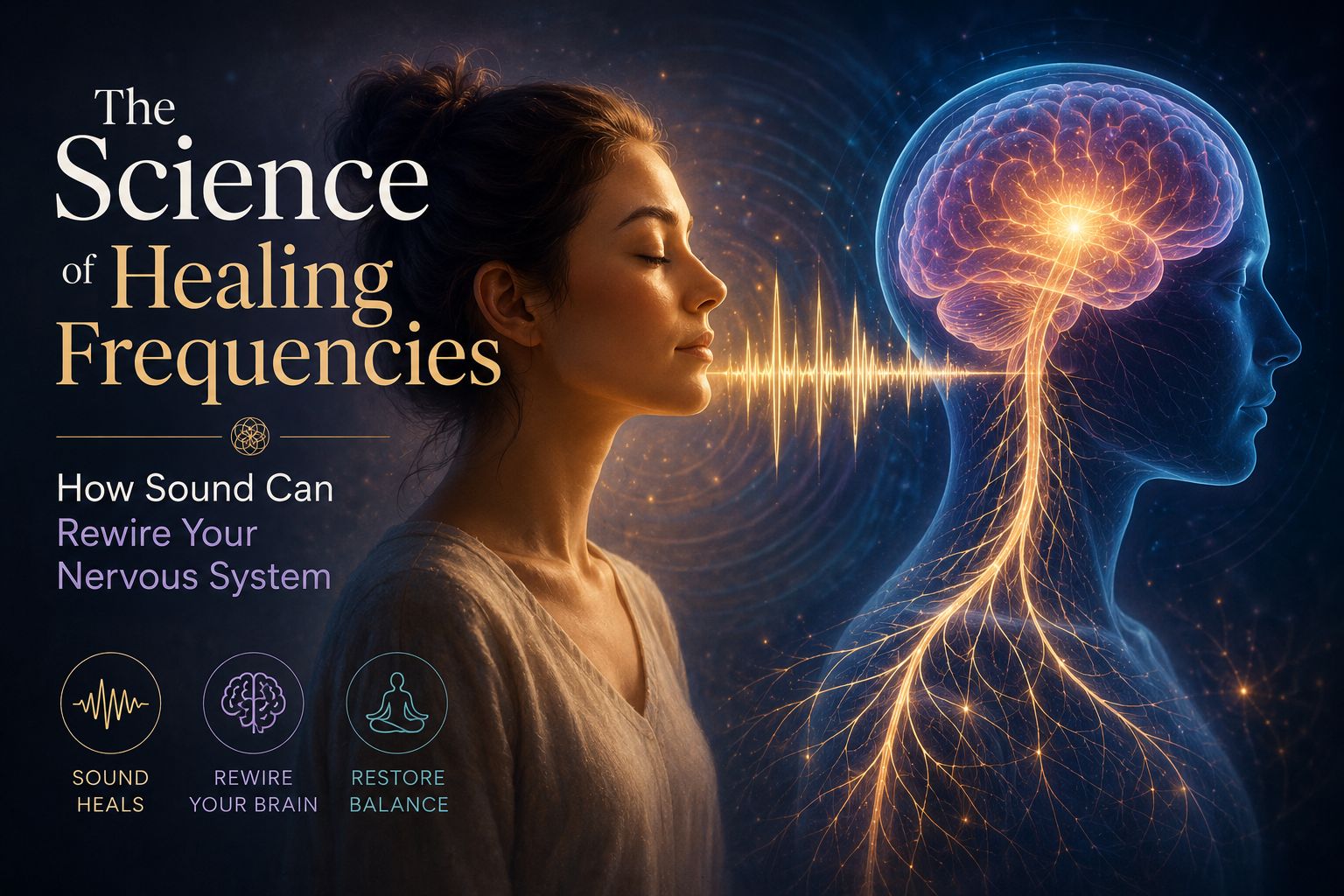
The Science of Healing Frequencies: How Sound Can Rewire Your Nervous System
There is a moment most of us know well. The workday ends, the door closes, and yet the body refuses to follow. The jaw stays tight. The shoulders stay raised. The mind keeps running its loops — replaying conversations, rehearsing tomorrow, calculating everything that could go wrong. Sleep feels far away. Stillness feels impossible.
What if the fastest path back to yourself wasn’t a pill, a practice, or a protocol — but a sound?
This is not mysticism. This is neuroscience. And in the last two decades, research into the relationship between sound frequencies and human physiology has produced findings that are quietly changing how we understand the brain, the nervous system, and the body’s extraordinary capacity to heal itself.
Sound Is Not Just Something You Hear
Most of us think of sound as an experience that happens in the ears. But the moment a sound wave enters your body, it becomes something far more physical than that.
Sound is vibration. It travels through air as a wave of pressure, enters the ear canal, and sets the eardrum in motion. From there, the mechanical energy is converted into electrical signals that travel through the auditory nerve into the brainstem — and from the brainstem, those signals fan out across nearly every major system in the body.
The vagus nerve — the long wandering nerve that regulates heart rate, digestion, inflammation, and the stress response — is directly influenced by auditory input. The hypothalamus, which controls cortisol release and the autonomic nervous system, responds to acoustic stimulation. Even the immune system has documented sensitivity to sound-induced stress reduction.
In other words, when you hear something, your entire body is listening.
The Nervous System and the Stress Trap
To understand why frequencies matter, you first need to understand what stress actually does to the body.
The autonomic nervous system operates in two primary modes. The sympathetic mode — commonly known as fight-or-flight — floods the body with cortisol and adrenaline, raises heart rate and blood pressure, tightens muscles, and sharpens focus toward perceived threat. This system evolved to keep us alive in moments of genuine danger. It is extraordinarily good at its job.
The problem is that in modern life, it rarely switches off.
Emails, deadlines, financial pressure, relationship tension, social comparison — none of these are lions. But the nervous system cannot tell the difference. It responds to psychological threat with the same physiological cascade it would deploy for a physical one. And when the sympathetic state becomes chronic, the damage compounds: elevated cortisol suppresses the immune system, disrupts sleep architecture, impairs memory consolidation, accelerates cellular aging, and significantly increases the risk of cardiovascular disease.
The antidote is the parasympathetic nervous system — the rest-and-restore mode. This is the state in which the body repairs itself, consolidates memory, regulates emotion, and returns to equilibrium. The question is how to get there — and how to get there quickly, reliably, and without adding another demand to an already overloaded life.
This is where frequency engineering enters.
Brainwave Entrainment: Teaching the Brain a New Rhythm
The brain is an electrical organ. At any given moment, billions of neurons are firing in patterns — and those patterns produce measurable electrical oscillations called brainwaves. Different states of consciousness correspond to different dominant frequencies:
| Delta (1–4 Hz) | Deep, dreamless sleep. Physical restoration. Immune function. |
| Theta (4–8 Hz) | Light sleep, deep meditation, creative insight, emotional processing. The state where memory consolidates and unconscious material surfaces. |
| Alpha (8–13 Hz) | Relaxed wakefulness. Calm focus. The parasympathetic state. The antidote to cortisol. |
| Beta (14–30 Hz) | Active thinking, problem-solving, alertness, concentration. |
| Gamma (30–100 Hz) | High-level cognitive processing, learning, neuroplasticity. |
Most people under chronic stress spend the majority of their waking hours locked in high-beta — a state of sustained mental tension that the brain eventually struggles to exit on its own. Meditation can shift this, but meditation takes years of practice to do reliably. Sleep can shift it, but stress impairs sleep quality in a cruel feedback loop.
Brainwave entrainment offers a different path. It is based on a well-documented neurological phenomenon: the brain has a natural tendency to synchronize its electrical activity to rhythmic external stimuli. This is called the frequency-following response. When exposed to a consistent rhythmic pulse at a specific frequency, the dominant brainwave activity gradually shifts toward that frequency.
In practical terms: if you expose the brain to a 10 Hz rhythmic stimulus while it is running at 25 Hz stress-beta, it will — over 10 to 15 minutes — begin moving toward 10 Hz alpha. Measurably. Demonstrably. On an EEG.
Binaural Beats: The Most Researched Method
The most studied method of delivering brainwave entrainment is the binaural beat — a phenomenon discovered by physicist Heinrich Wilhelm Dove in 1839 and brought into modern neuroscience in the 1970s by researcher Gerald Oster.
The mechanism is elegant in its simplicity. When two pure tones of slightly different frequencies are played simultaneously — one into each ear through headphones — the brain perceives a third tone equal to the mathematical difference between the two. Play 200 Hz in the left ear and 210 Hz in the right, and the brain generates a rhythmic pulse of 10 Hz. This pulse does not exist in the air. It is created entirely within the auditory cortex as the brain attempts to reconcile the two signals. And because this 10 Hz pulse is generated inside the brain itself, it has direct access to the brain’s electrical rhythms.
Multiple controlled studies have confirmed measurable effects. A systematic review published in Psychological Research found that alpha-range binaural beats consistently produced reductions in anxiety scores. Research published in the Journal of Alternative and Complementary Medicine documented significant reductions in heart rate and blood pressure following binaural beat sessions. A 60-day study found that regular delta binaural beat listening substantially improved sleep quality and reduced anxiety in participants who had previously struggled with both.
A 2020 study on gamma-frequency stimulation — specifically 40 Hz — found remarkable potential for cognitive enhancement and neuroplasticity, with implications for neurological recovery and aging brain maintenance.
This is not fringe science. These are peer-reviewed findings, replicated across multiple research teams, pointing consistently in the same direction: specific frequencies, delivered precisely, produce specific physiological and neurological effects.
The Role of Carrier Frequencies
Binaural beats require a carrier — the audible tone that the entrainment signal rides on. The choice of carrier frequency is not arbitrary.
Much attention has been given to 432 Hz — an alternative tuning for the musical note A, set slightly below the standard concert pitch of 440 Hz. Researchers have found it psychoacoustically warmer and less tension-inducing than standard tuning. Whether or not all claims around 432 Hz are fully verified, its subjective effect on listeners is consistent: it feels more restful, more grounding, more natural.
Other carrier frequencies carry their own documented associations. 174 Hz, used in tracks targeting pain reduction, is associated in music therapy contexts with analgesic relaxation effects. 528 Hz — sometimes called the repair frequency — has been the subject of early research suggesting potential effects on cellular stress markers. 396 Hz is associated with the release of fear and tension in sound therapy traditions, and sits in a range that complements low-frequency entrainment work.
These carrier frequencies are not magic numbers. They are deliberate choices — made to enhance the listening experience, support the entrainment mechanism, and create a coherent sonic environment that the nervous system can relax into.
Why Music Matters: The Fourth Layer
Frequency engineering alone — sine waves and binaural pulses — can produce entrainment. But it produces an experience that is clinically effective and aesthetically unpleasant. Most listeners cannot sustain attention to bare tones for 30 to 45 minutes. And attention matters: passive, distracted listening reduces entrainment efficiency.
This is where music becomes not decoration, but mechanism.
A carefully composed musical surface — ambient, non-rhythmic, emotionally neutral but warm — serves multiple functions simultaneously. It gives the conscious mind something to rest on, reducing the restless scanning that disrupts relaxation. It engages the emotional brain in a non-stimulating way, keeping the listener present without arousal. And it carries the frequency layers beneath it in a way that feels natural rather than clinical.
The most effective frequency tracks are engineered in layers: a binaural beat engine buried beneath consciousness, an isochronic reinforcement layer for those listening on speakers, a sustained harmonic drone rooted in the chosen carrier frequency, and above all of it, a composed musical landscape — sparse, breathing, unhurried — that makes the listener want to stay.
This is the intersection where neuroscience meets art. And it is where the most powerful work in this field is being done.
What You Can Actually Expect
Let me be precise here, because precision is what separates this work from the vast noise of wellness marketing.
Frequency-based audio is not a cure. It does not heal disease, replace therapy, or substitute for medical treatment. What it does — reliably, measurably, and with a growing body of research behind it — is shift physiological and neurological state.
After a well-designed alpha-frequency session, cortisol levels are measurably lower. Heart rate slows. Blood pressure drops slightly. The subjective experience of anxiety reduces. These are not placebo effects — they have been measured in double-blind conditions.
After a delta-frequency sleep session, time spent in slow-wave sleep increases. Morning cognitive performance improves. The immune markers associated with restorative sleep show positive shifts.
After a theta-frequency session targeting memory, consolidation of recently learned information improves. Creative ideation increases. The emotional residue of difficult experiences becomes more accessible and more processable.
After a gamma-frequency session, reaction time, processing speed, and working memory show measurable improvements. Over extended use, the research on 40 Hz stimulation suggests potential benefits for long-term neurological health.
These are real effects. They are modest in a single session and cumulative with regular use. Think of it less like taking a painkiller and more like training a muscle — consistent practice builds a nervous system that is better at returning to equilibrium, more resilient to stress, and more capable of the deep rest it was designed for.
A New Kind of Listening
We are living through a moment of profound rediscovery. Ancient cultures — from Tibetan monasticism to Greek Pythagorean tradition to Persian classical music — built entire healing systems around the therapeutic use of sound. Modern neuroscience is now beginning to understand, in precise mechanistic terms, why those systems worked.
The tracks I am creating for this collection are built at the intersection of these two traditions. Each one is engineered around a specific physiological target — a documented effect, a measurable mechanism, a precise frequency chosen for its neurological action. And each one is composed as music — as something worth listening to, something that rewards the 30 minutes you give it.
You do not need to believe in the frequencies for them to work. The brain does not require belief to follow a rhythmic stimulus. You only need to listen — with headphones, with eyes closed, with the willingness to be still for a moment.
The nervous system will do the rest.
Explore the Collection
16 tracks. Each engineered for a specific state. Fully documented frequencies, mechanisms, and listening protocols.
Browse the Tracks →These tracks are available individually and in curated bundles in the shop. Each comes with full documentation of the frequencies used, the mechanisms involved, and recommended listening protocols. Headphones are required for full effect.
Does the research suggest that certain frequencies are consistently more effective, or is the individual’s response more important?
That’s a great question. Current research suggests that the individual’s response is often more important than any single “special” frequency. Factors such as your emotional state, nervous system, listening environment, and consistency of practice all play a significant role. While some frequencies have been studied more extensively than others, there isn’t strong scientific evidence that one specific frequency works universally for everyone. In practice, the most effective sound is often the one that helps you relax, regulate your nervous system, and remain present.
This article helped me understand that the goal isn’t to ‘fix’ the brain, but to create conditions that support relaxation and nervous system regulation. Thank you so much.
Exactly. Sound healing isn’t about “fixing” the brain, but about supporting the body’s natural ability to find balance. By creating an environment that encourages relaxation, sound can help shift the nervous system away from a prolonged stress response and toward a calmer, more regulated state. While it’s not a substitute for medical or psychological treatment when those are needed, many people find that regular sound-based practices become a valuable part of their overall wellbeing routine.
Thank you. 🙏🏻🪷
I’ve heard about alpha, theta, and delta brainwaves before. Is there evidence that sound can help guide the brain toward these states?
Yes, there is growing evidence that certain types of sound, especially rhythmic stimulation and binaural beats, can help encourage the brain toward states associated with alpha, theta, or delta brainwave activity. This process is often called brainwave entrainment, where the brain gradually synchronizes with an external rhythmic stimulus. Research suggests it may support relaxation, meditation, improved focus, or sleep in some people, although individual responses can vary and the scientific evidence is still developing.
The goal isn’t to force the brain into a particular state, but to create conditions that make those calmer brainwave patterns more likely. That’s why many sound healing recordings are designed with specific frequencies and rhythms to support relaxation, meditation, or deep sleep, depending on the intended outcome.