
Resonant Pathways: The Transformative Voice of Tibetan Singing Bowls in Sound Healing
Tibetan Singing Bowls in Sound Healing
There are moments when a single tone can transform the atmosphere of a room. A Tibetan singing bowl does this not by force, but through vibration that expands gently into space — filling the environment from the inside out.
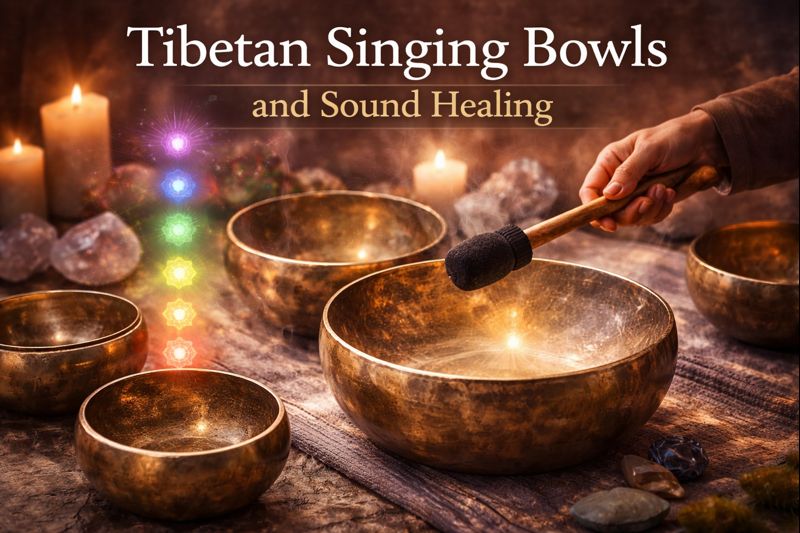
Its sound lingers long after the strike, travelling through the air, through the body, and sometimes through layers of awareness that words cannot easily reach.
History and Origins
Despite their modern popularity, the exact origins of singing bowls remain surrounded by mystery. Many people refer to them as “Tibetan Singing Bowls,” although historical evidence suggests similar bowls were produced across Nepal, Tibet, Bhutan, Northern India, China, and the Himalayan mountain ranges.
Traditional metal bowls have been used for centuries as eating vessels, offering bowls, ritual objects, temple implements, and meditation tools. The modern use of bowls as dedicated sound healing instruments developed largely during the twentieth century as Eastern contemplative practices became more widely known in the West.
Today, Nepal remains one of the world’s most important centers for hand-hammered singing bowl production, with many bowls still crafted by families using traditional metalworking techniques passed down through generations.
The Sacred Symbolism of the Bowl
The bowl itself carries deep symbolic meaning. Its circular shape reflects wholeness, unity, cycles of nature, and the continuous movement of life. Unlike many instruments that project sound in a specific direction, a singing bowl radiates vibration in all directions — making it an ideal instrument for presence, meditation, inner listening, and energetic awareness.
The bowl becomes less of a musical instrument and more of a vessel for vibration.
Types of Singing Bowls
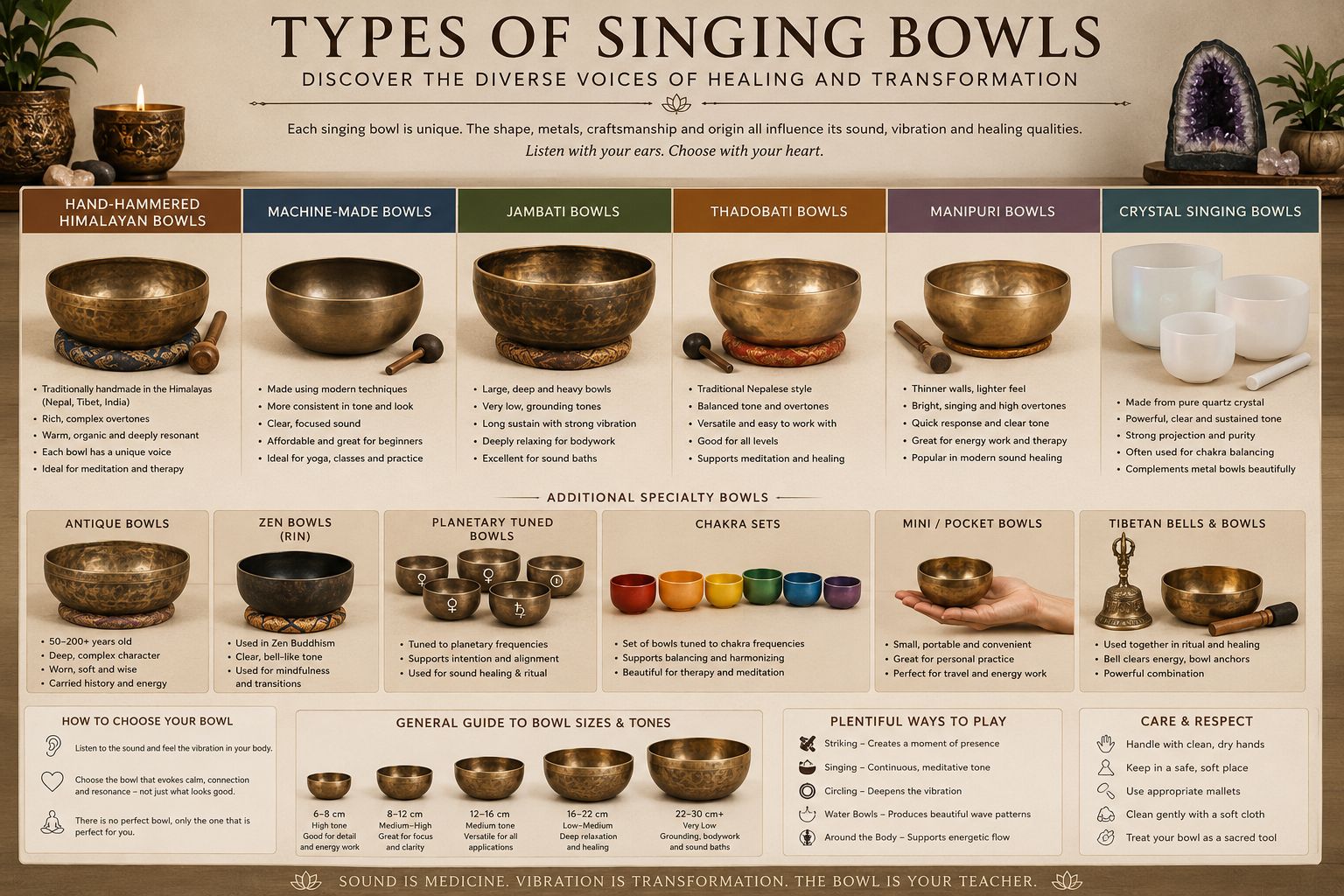
Hand-Hammered Himalayan Bowls
Traditionally crafted through repeated heating and hammering. Rich in overtone complexity, warm and organic in sound, with a strong vibrational presence. No two bowls are identical — often preferred by sound healing practitioners seeking depth and character.
Machine-Made Bowls
Created using modern manufacturing techniques. More uniform in tuning and appearance, with clearer tones and less overtone complexity. Often suitable for beginners and musical applications.
Jambati Bowls
Large, deep bowls traditionally associated with Nepal. Known for their deep grounding tones, long sustain, and strong physical vibration. Often used for body-centered sound healing.
Thadobati Bowls
A more common traditional style with a balanced, versatile tone. An excellent all-purpose bowl — popular among both beginners and professionals.
Manipuri Bowls
Characterized by thinner walls and lighter construction. Brighter sound, faster response, and higher overtones. Often used for meditation and energetic work.
Crystal Singing Bowls
Made from pure quartz crystal, these are technically different from Himalayan bowls but frequently used alongside them. Known for clear sustained tones, powerful projection, and strong tonal focus — often used in chakra-focused sessions.
Why Material Composition Matters
Unlike many instruments that produce a single pure tone, Tibetan singing bowls create a complex field of frequencies shaped by metal composition, thickness, diameter, depth, hammering process, age, and playing technique.
In sound healing this matters because the fundamental tone creates grounding and presence, overtones encourage spaciousness and expanded awareness, and the balance between them shapes emotional response. The body does not only hear vibration — it absorbs it.
How Singing Bowls Affect the Body and Mind
When a bowl vibrates, it produces multiple frequencies simultaneously. These interact with hearing, breath, nervous system activity, attention, emotional processing, and bodily awareness.
Clients Often Report
- Warmth moving through the body
- Tingling sensations
- Relaxation of jaw and shoulders
- Slower, deeper breathing
- Emotional softening
- Enhanced mental clarity
Singing bowls naturally support parasympathetic activation, mindfulness, relaxation, presence, and emotional integration. Where rhythm organizes, tone opens.
Harmonics, Overtones, and the Living Sound
Every singing bowl contains one fundamental tone, multiple harmonics, and multiple overtones. These layers create the bowl’s unique acoustic signature. Unlike electronic tones, singing bowls produce a constantly evolving sound field — keeping the listener engaged without requiring effort. This is one reason bowl meditation can feel both calming and captivating at the same time.
Intervals and Bowl Sets
When multiple bowls are used together, their relationships create intervals — each carrying a different quality. Octaves feel grounding and coherent. Fifths feel spacious and stable. Thirds carry emotional resonance. Practitioners often choose bowl combinations based on felt experience rather than strict musical theory. The body becomes the guide.
Working with Chakras and Energy Centers
Many practitioners associate bowl frequencies with energetic centers — lower tones with the root and sacral, mid-range with the solar plexus and heart, higher tones with the throat, third eye, and crown. However, there is no universal system. Two bowls tuned to the same note may feel entirely different.
Playing Techniques
Striking
A padded mallet strikes the bowl and allows its tone to unfold naturally. The most familiar and accessible technique.
Singing
The mallet is rubbed around the rim, causing the bowl to “sing.” This creates a continuous tone and sustained resonance.
Water Bowls
Some practitioners add water to large bowls. The vibration creates beautiful visible patterns and moving waves — a powerful visual and sensory addition to a session.
Bowl Placement
Bowls may be played around the body, placed near specific areas, used within the energy field, or played in the room as ambient resonance. Each placement creates a different quality of experience.
Choosing the Right Bowl
When selecting a bowl, listen for sustain, overtone richness, vibrational strength, and comfort of tone. A bowl may be perfectly tuned yet not resonate with you.
Trust both your ears and your body. The best bowl is not necessarily the most expensive — it is the one that creates a meaningful relationship with your listening.
Safety Considerations
- Avoid excessive volume
- Use care near sensitive ears
- Be cautious around acute migraines
- Reduce intensity for highly sensitive clients
- Always prioritize comfort over intensity
Healing comes through resonance, not force.
Why Singing Bowls Support Emotional Integration
Vibration reaches places where thought cannot. Unlike conversation, sound does not demand explanation, does not require analysis, and does not insist on solutions. It simply creates space. Within that space, emotions often find their own path toward movement and resolution.
Clients Often Experience
- Clarity without words
- Emotional release
- Greater self-awareness
- A sense of inner harmony
The bowl becomes a container for what is ready to unfold.
After the Sound: Integration and Rest
When the bowl becomes silent, the process continues. Useful integration practices include rest, hydration, journaling, gentle movement, time in nature, and reflective observation.
The sound may stop. The resonance often continues.
“Through their voice we learn to listen again — not only with the ears, but with the whole body.”
And in that listening, many people rediscover something surprisingly simple and profoundly important: the feeling of being fully here.
Really enjoyed this piece! Singing bowls are such a powerful and timeless part of sound therapy, and this article perfectly captures why their vibrations feel so transformative.
I’ve always found the sound of Tibetan singing bowls incredibly calming. Is there a reason their tones feel so different from other instruments?
And can beginners benefit from using a single singing bowl at home, or is it better to experience a guided sound healing session first?
Thank you! Tibetan singing bowls produce a rich combination of fundamental tones and complex overtones that continue to evolve as the bowl resonates. This creates a deep, immersive sound that many people find calming and meditative. Their sustained resonance and harmonic complexity are quite different from most conventional musical instruments, which is one reason they evoke such a unique listening experience.
For beginners, a single high-quality singing bowl can be a wonderful place to start and is often enough to build a simple personal practice. However, experiencing a guided sound healing session first can be very valuable, as it helps you understand different techniques, instruments, and ways of listening. Many people begin with guided sessions and later incorporate a singing bowl into their own mindfulness or relaxation routine at home.
They are designed to be safe for regular use, and in fact, daily listening often provides the best results. Just like meditation or breathwork, consistency helps train the nervous system over time. You don’t have to wait until you’re feeling stressed or anxious to use them. Many people find that listening for 15-30 minutes a day helps maintain a greater sense of calm, improve resilience to everyday stress, and support better sleep. Of course, you can also use a specific track whenever you need extra support during particularly stressful moments.